Ulster on the up!

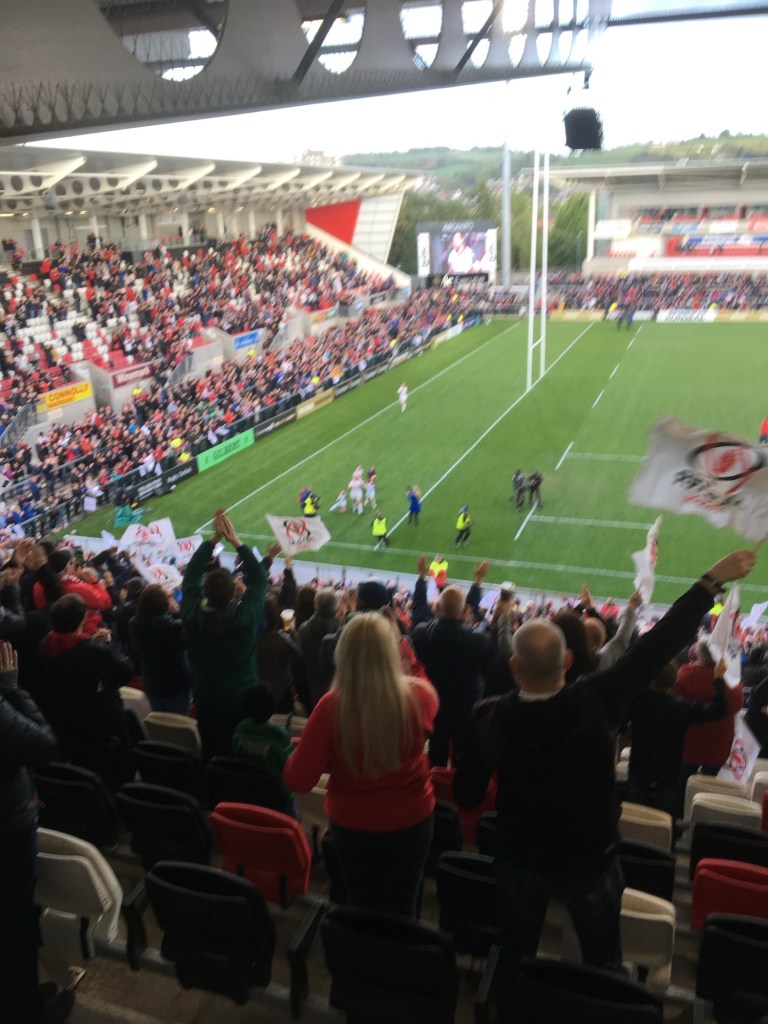
As 2026 begins, Ulster rugby fans are heartened by the team’s recent upward curve. Following a disappointing couple of years, there’s now genuine positivity over the team’s performances.

At the time of writing, Ulster are fifth in the URC table, with a game in hand over their top table rivals, and positioned very well for this stage of the season. But it’s the manner of performances that stands out.

The Ravenhill side has been a joy to watch this season, scoring lovely tries and creating plenty on the edges. There’s a clear emphasis on ball in hand and players are clearly encouraged to attack. The overall shape looks sharp and impressive.

Richie Murphy has settled in well now, but key to this season’s transformation is attack coach, Mark Sexton. A former Irish Under-20s coach, Sexton evidently shares his brother’s rugby intelligence and joy of developing strategies for unlocking defences. Sexton’s impact was not so much quick as immediate.

For a team so long in stasis, the emergence of young players like Jude Postlethwaite, Zac Ward and Tom Stewart catches the eye. Suddenly, the team has options, and is no longer reliant on a handful of key players. There’s genuine competition within the squad and that excites.

There’s a long way to go, of course, and Ulster are still a few players short of being a top European side. No-one’s getting carried away by any stretch of the imagination. But Ulster’s improvement is tangible and they deserve credit on the progress to date. Exciting times in Belfast. If they continue like this, we’ll all be standing up for the Ulstermen at the end of the season.

@rorymcgimpsey.bsky.social

An Impossible Reunion?

So, Dan McFarland has stepped down as Ulster coach. The departure was inevitable. It’s not so much results, as disappointing as they’ve been of late, but the maddeningly inconsistent nature of performances.

It started quite well for him. Initial performances were good and, in the early days, Ulster gained a consistency that eluded McFarland’s predecessors. But, alas, that didn’t translate into silverware or success. The same old story.

It’s important to mention that the sole responsibility for the malaise doesn’t rest with the coach. In recent years, Ulster have become increasingly reliant on big, marquee signings, mostly from South Africa.

These acquisitions are impressive: Coetzee, Vermuelen and Kitschoff. But the stardust is at the expense of developing and nurturing homegrown talent. Yes, the Ulster system produces plenty of local players, but how many have developed into genuinely world class operators?

You can count on one hand how many have progressed as fully fledged and seasoned Irish internationals. Arguably, the most talented local, homegrown players have regressed under this regime’s management. That’s its biggest indictment.

But it’s not just the signings. Ulster have been sprinkled liberally with players from the other Irish provinces. In recent times, the side has felt like a version of Leinster ‘A’. And, yes, I know that wasn’t always Ulster’s call. There’s a bigger picture there. But it’s a symptom of the province’s regression from what it used to be.

Therefore, the issues are institutional. There are no quick fixes. To regain success (Ulster’s last trophy was in 2006), the province must move away from over reliance on those marquee signings and return to the bread and butter of nurturing local players.

Just the way Leinster does. It’s not enough to merely cultivate local players, the system must breed excellence. The yardstick is how many become regular and enduring Irish internationals. That’s a harsh lesson, but a truthful one.

Richie Murphy comes in to stabilise, but there are bigger issues to address. A fairly substantial reset is needed. It won’t happen overnight, but investment in youth and excellence will bear fruit eventually. The raw materials are there. But Ulster must stick to that vision.

Perhaps Murphy is the long term answer, but I feel a more experienced hand is needed to steady the ship initially, but also lay the groundwork for future success, to re-establish a vibrant, high performance culture.

The solution rather than belonging to the future may well lie in Ulster’s past. I’m pretty sure it won’t happen, but if Ulster’s kingmakers had any sense, they would land at Mark McCall’s door and ask what it takes to get him home. It’s been a frustrating time for the northern province, but in the right hands, the potential is immense.

@rorymcgimpsey

World in Their Hands

Ireland’s World Cup campaign is underway and we’re excited by the prospects. The team’s in good shape: a talented playing group, superb coaches, top form, and a relatively clean bill of health.

There are caveats. Ireland are in the toughest group and even if they come out unscathed, it’s a hard old route to the semi-finals and beyond. That said, they’ll never have a better chance.

March’s Grand Slam was preceded by the historic series win in New Zealand. Indeed, the Irish have achieved consistently under Andy Farrell, all the while playing supremely attractive yet winning rugby.

Jonny Sexton still pulls the string superbly and looks fresher than ever following his recent layoff. But it’s the strength in depth that excites. There’s substance in every position, with understudies as capable as the front line.

And Farrell has brought through so many gems. Lowe, Hansen, Baird, Gibson-Park and Doris, to name but a few.

The head coach isn’t afraid to take chances with new blood and backs the entire squad to deliver under pressure. An already talented group is supplemented with extra quality. That stands the Irish in good stead for the challenges ahead.

Setbacks will happen, of course. Injuries are inevitable and the path to the latter stages is lined with difficult opponents. Such enterprises never run smoothly. Nevertheless, Ireland are smart, astute and confident.

Whisper it quietly, but the signs are good. Notwithstanding the unforgiving draw, Ireland are primed to make history and, finally, fulfil their potential on the biggest stage. The rewards are there if they get it right. Opportunity beckons.

P.S. I always watched big rugby tournaments with my dad. World Cups, Six Nations, Lions’ Tours. You name it. Dad passed away in May and the World Cup is the first one without him. It feels weird.

That’s probably the hardest thing about losing someone. The world goes on without them. They miss out and it doesn’t seem right. Certainly, big rugby events will never be the same for me again. No doubt, regardless of how Ireland get on, I’ll be enjoy this World Cup immensely. But there’ll always be someone missing.

@rorymcgimpsey

An Andy Way to Work

At the time of writing, Ireland are three from three in the 2023 Six Nations Championship. Following on from the uber successful tour of NZ in the summer, Irish rugby is sure in a good space. As the old cliche goes, winning is very much a habit. But what has caused this successful turnaround?

To my mind, the key factor is Andy Farrell. Farrell has brought so much to the Irish set up. Consistency of performance hit new heights under the venerable Joe Schmidt but, against the odds, the former rugby league man has pushed standards even further. The proof is there for all to see. So, what has Farrell done?

The primary thing that Farrell has provided is the infusion of a winning mentality. Sure, Ireland has a group of talented and ambitious players, but it’s the mind-set of the group that impresses most. These guys expect to win. Not in an arrogant way, but they fear no-one. And they’re relentless in maintaining and improving standards of performance.

Here, Farrell’s influence is key. A product of that splendid Wigan rugby league side of the ’90s, Ireland’s coach was brought up in an environment where winning was not just desirable but essential. It was mandatory. That side was marvellous. And Farrell was an integral component of it. You see that relentless attitude within the current Irish playing group.

What’s wonderful as well is the brand of rugby currently played. It’s pleasing on the eye and there’s a massive emphasis on individual and collective skills. Schmidt’s side was the archetype of systemic rugby, where everyone was meticulously drilled within their roles. It was functional rather than overtly creative.

Farrell’s side plays differently. The players clearly have licence to play what’s in front of them. If it’s on, they routinely go for it. And, delightfully, the offload is no longer an endangered species. Don’t get me wrong. It’s all curated within a definite shape and structure, and the team is as well organised as it’s ever been. But it’s not restrictive. There’s no straight jacket at play.

And they’re doing it with smiles on their faces. This Irish team is evidently enjoying its rugby. Work is an opportunity to improve, grow and develop. It’s not onerous in any way. The players are clearly relishing the challenge.

One example of the elite nature of this environment is the way in which Ireland have coped with injuries. A succession of players have gone down, but replacements have slotted in seamlessly. For instance, Stuart McCloskey has thrived with his belated chance at a regular run. Similarly, Finlay Bealham has excelled covering for the once indispensable Tadhg Furlong. Players have slotted in and out pretty effortlessly.

Such understanding only happens within a highly competitive and organised environment. All credit goes to the coach. The Schmidt era was the high water mark for Irish rugby. And, yet, his successor has taken performance to another level entirely. Success is never guaranteed in any walk of life but, heck, it’s coming pretty regularly these days at Lansdowne Road. We’ll soon see if the precious Slam lands, but these days it’s very unwise to bet against Andy Farrell’s men.

P.S. The Rolling Stones are reportedly collaborating with the surviving Beatles on their new album. Some are surprised at the move. But these guys have always been great friends. The supposed rivalry was always over hyped and as much a media invention as anything else. After all, it was Lennon and McCartney that gave the Stones their first major UK hit.

What this project ends up as, who knows. But even if McCartney and Starr only play on a couple of tracks, how fantastic is that? I’m excited to see what materialises. Because we’re running out of time to make this type of history. Bring it on!


@rorymcgimpsey

Promotion of a Lion!

It was mooted this week that Andy Farrell is in the running to be Lions’ head coach for their tour of Australia. The IRFU has stated that it won’t stand in the way if its main man is indeed the choice. Good news for Farrell and for rugby fans alike as Farrell’s appointment, if rubber stamped, is a shrewd move.

Interestingly, though, Farrell’s would-be promotion creates an opportunity for one of our own to shine in his absence. You don’t need to be Sherlock Homes to deduce that Paul O’Connell is being lined up to succeed Farrell as Irish head coach. When the Munster legend was catapulted into the Irish set-up a couple of years ago, all signs pointed to this being an integral part of the IRFU’s succession plan for the national team. The universal plaudits O’Connell has received since his arrival attest to the monumental impact he’s made.

Therefore, it makes perfect sense that in the event of Farrell shipping off with the Lions, O’Connell is a ready made stand in. Sounds like the perfect plan, right? Of course, these days Lions coaches get carte blanche to pick their assistants and the former Wigan man may well want his Irish assistant with him in his jaunt down under if appointed to the Lions. However, from an Irish perspective, it makes sense for O’Connell to deputise with Ireland while his boss is away with the Lions, should that scenario come to pass.

So, although the IRFU has said it won’t stand in Farrell’s way should the Lions come knocking, will its condition be that O’Connell stays put for the duration of the Australian tour? I imagine the union won’t want to lose both its star coaches to the Lions when Lions’ tours always provide such great developmental opportunities for the players left behind. For Irish rugby, the dream scenario is Farrell leads the Lions to an historic series victory and that O’Connell stays behind to begin his apprenticeship as Ireland head coach in waiting.

Of course, much water has to pass under the bridge for any of the above to emerge. Life is fluid and things change very quickly. One day, you’re hot and the next you’re, well, not. But, all things being equal, this series of events could work out very well for all concerned in Irish rugby. The road map for succession is laid out before our eyes and few rugby nations are in as strong a position. Big Paul striding into his first press conference as head coach, you sense the excitement just thinking about it. With Farrell linked to the Lions’ job, Irish rugby has talked about contingency. That contingency has to be Paul O’Connell.

@rorymcgimpsey

Redemption Required

As we survey the first two rounds of the Six Nations, Ireland find themselves in a tight spot. Two games played, two losses is not a good stat, but it’s the manner of the defeats that concerns. Andy Farrell’s men have been no better than mediocre and although there’s plenty of endeavour, stardust is pretty thin on the ground.

Most worrying of all is the listless nature of Irish performances and the inability to score tries. There was, at least, a semblance of attacking shape in Ireland’s opening loss to Wales and the visitors played quite well until Peter O’Mahony’s moment of madness tilted the game in Wales’s favour. In fact, Ireland’s performance with 14 men was pretty spirited, in fairness.

However, even then, Farrell’s men only managed one try. If Irish underperformance was understandable in that context, the French game last week was a severe regression. In terms of attacking ideas, Ireland were virtually non-existent, the only innovation being, err, the tactical novelty that is the Garryowen!

If you didn’t know better, you’d swear it was mid-nineties’ fare. And despite the tactic clearly not working, Billy Burns and his outside backs kept coming back to it-the definition of insanity and all that.

Speaking of Burns, the Ulster ten showed again that he is slightly lacking at the highest level. Don’t get me wrong, Ireland’s reserve fly-half is a decent provincial player who’s done fine things for his club these past couple of seasons.

But he is not yet equipped to boss and dominate a Six Nations encounter at this elite level. Ditto Ross Byrne. Ross’s brother Harry may be the heir apparent, but throwing a supremely talented young fella in at the deep end isn’t the answer either.

So, what does that leave us with? Johnny Sexton! Sexton remains Ireland’s best ten by a country mile, even in the autumn of his career. And that’s a disconcerting thought.

Ireland’s best ever ten has to retire at some stage, but the thought is currently inconceivable given the lack of viable contenders for the throne. Until Joey Carbery returns, there just isn’t an alternative anything close to the same level.

That said, it’s unfair to highlight individuals in discussing Ireland’s lack of creative spark. Farrell has been in the top job for well over a year now and yet his vision is hard to discern.

A brilliant assistant and defence coach, what does an Andy Farrell side look like? What are the hallmarks? We’re still not sure. Yes, there’s plenty of huff, puff and toil, but what’s the grand plan? Integral to all this is Mike Catt.

An unlikely choice, maybe, as attack coach, Catt’s vision is also proving elusive. Apart from his stellar playing career, Catt’s coaching resume is limited, bar a spot on Stuart Lancaster’s doomed England coaching ticket, and a support role with Conor O’Shea’s Italy in recent seasons.

We’ve discussed before the lack of superstars in Ireland’s current panel, but a lack of ambition is altogether harder to defend. Catt may yet prove to be brilliant, but it’s been a baptism of fire so far.

In terms of proving his credentials, however, Ireland’s next opponents, Italy (a side Catt obviously knows well), is a decent place to start!

And that’s the problem for Ireland. The Six Nations is all about momentum and after two rounds, Farrell’s men are playing catch up. Italy will fancy their chances of upset, but even an uninspiring Ireland should have enough to get the job done.

But even then, Ireland still finish with two really tough games: a revitalised Scotland away and then old enemy England at home. Who’d be in Farrell’s shoes?!

And that’s the catch-22. Ireland’s coach needs to experiment a little and spread his wings. He also needs to roll the dice in terms of selection. After all, the World Cup is only two years away.

But he also needs to win or he’ll lose his job. That’s why the Wigan great has so little room for manoeuvre. It’s the tightest of balancing acts.

This is the ultimate transition phase. As anyone who followed Ireland in the late nineties knows, transition phases are zero craic. For what it’s worth, I think Ireland will regroup and recover well.

They may even win all three remaining games. But Farrell needs performances to match. Now, more than ever, his players need to stand up and be counted for him.

P.S. I’ve just finished the comedian, David Baddiel’s new book, Jews Don’t Count. It makes for a fascinating, if at times, uncomfortable read. Nominally about anti-Semitism, Jews Don’t Count focuses on the blind spot held by many progressives in discussing the issue compared to other forms of racism.

It is extremely thought provoking and challenging for anyone not from a Jewish background. It forces us to confront some truths which are difficult to acknowledge. But it’s an important work and everyone, regardless of political persuasion, should read it. It is essential reading. I’m glad I did and it’s helped me look inwards-in a really good way!

@rorymcgimpsey

An Injection of Dog

Don’t know about anyone else, but I’m quite underwhelmed by rugby at the moment. I know it’s a necessary evil, but the sight and sound of empty stadiums just doesn’t do it for me. I must confess I’ve watched very little action recently and struggle to keep up with developments.

However, some recent news genuinely excites me. The appointment of Paul O’Connell as the Irish forwards coach is a masterstroke by the IRFU. Just when the titan of all titans seemed lost to the professional sport in Ireland, we have a welcome if unexpected addition to Andy Farrell’s coaching ticket. A wonderful bit of business.

The Limerick man is a colossal leader and adds significant value to any team he’s part of. A terrific orator, of course, and a genuinely hard man, the former Irish captain is a figure that inspires respect and fear in equal measure among opponents. But that’s only part of it. O’Connell is a much more intelligent and thoughtful individual than many realise, and brings a huge amount of intellectual property to the set-up.

As a player, O’Connell was renowned for his endless hours dissecting opposition lineouts prior to games. He has a marvellous rugby brain, for sure. That said, the big man is still a scary and intimidating presence these days. I saw him at close quarters at Ravenhill a couple of years ago coming up the stairs and can confirm that Paul is a bear of a man.

I like also that Farrell is keeping Simon Easterby on the ticket. The two will work well together; reprising a relationship they had as Irish players who excelled at the set-piece from a tactical perspective. It’s actually quite an All Blacks’ move and reminiscent of Steve Hansen rejigging the roles and responsibilities in his brains trust a few years back. Keeping everyone on their toes. Irish rugby maximising the resources at its disposal.

Of course, in an ideal world, O’Connell would serve a longer apprenticeship before being catapulted into the unforgiving cauldron of Test rugby; preferably as head coach of Munster. We know from the bitter experience of Martin Johnson, the perils of cutting your international coaching teeth too early. But you have to take these opportunities when they arise. It’s undoubtedly a clever move by David Nucifora and the IRFU.

O’Connell will galvanise, motivate and organise the Irish forwards but will do so much more. For this is the return of a talismanic figure who will instil the ingredients the Irish pack has been missing these past couple of years. Expect Ireland’s maul, ruck and, of course, lineout (both offensively and defensively) to be significantly better with O’Connell calling the shots.

It’s exciting too to think of James Ryan’s future development under O’Connell’s mentorship. In my last blog, I spoke of a certain lack of ‘dog’ in the current Irish pack. The savvy appointment of Paul O’Connell goes a long way to fixing the problem.

@rorymcgimpsey

State Of The Union

As another year ends (as crazy a year as any of us can remember), we’re all in a bit of a reflective mood. This is as true in rugby as anything else. In a year that’s seen matches cancelled, competitions curtailed and fans exiled, the sport, at all levels, finds itself asking some existential questions. If that sounds hyperbolic, it’s also true of the unique times rugby finds itself in.

So, perhaps we can give Andy Farrell a bit of a bye-ball as we survey the first full year of his tenure. Given all that’s happening in the world, normal standards don’t apply, right? True. Except time stands still for no-one and for the ever keen and motivational Farrell, the honeymoon period is over. Now, more than ever, coaches must find a way to deliver and garner revenue for their employers in rugby’s darkest hour, financially.

And it’s not gone too badly. Irish performances under their head coach have been creditable. Results have been on the upper end of what we expect. Yes, England have remained frustratingly out of reach with their slick, power game, but most other opponents have been within Ireland’s reach. As regards England, they just have a stronger team at present. These things go in cycles.

More worrying, is the apparent inability of the Irish pack to dominate the biggest games at the highest level. It’s been a while since we’ve seen a truly dominant performance-probably the last time was Ireland’s historic win over the ABs at the Aviva in 2018. The likes of Caelan Doris and James Ryan are superb young players, with massive potential, but you sense a lack of dog in the current squad. Where are the Paul O’Connells in today’s crop? Then again, such legends only emerge once a generation.

And that’s the rub. Farrell and his coaches can only work with the raw materials at their disposal. I’ve said it before, but it bears repeating, how many current Ireland players would get into a World XV and/or a Lions starting XV? How many are at that level? I can think of: Ringrose, Ryan and Furlong (when fit). There aren’t too many others. Alas Sexton and Murray, while still very important, are past their peak at this stage of their Test careers. Sad but true, I think.

Considering the above, has Farrell delivered or fluffed his first year? I’ve seen some criticism of the lack of evolution in playing style since Schmidt left. Not entirely fair. There’s been new patterns on display and, at least, an intent to play with more width and invention. Although Ireland’s attack had got so blunt at the end of the Schmidt era, it’s hard to go backwards in that regard! As discussed, results have been okay and the coaches can only work with the players they have.

The jury is still out in terms of whether Farrell is the right man for Ireland at this juncture. Remember, this is his first head coach gig in what is, to all intents and purposes, his second sport. It’s easy to forget that! And a man so passionate, driven and ambitious is almost certainly worth sticking with; at least in the short term.

Maybe a deeper truth emerges. We can now appreciate how Joe Schmidt over achieved with this group of players in recent years. The golden generation is long gone and the nucleus of Schmidt’s team is past its peak for those that have not retired. I hate the term, but this is a transitional phase. Perhaps expectations should be corrected on that basis.

P.S. It’s been a strange old year for everyone. 2020 is like the year that never got going. It started normally enough, but then took a turn none of us predicted. It’s been tough, weird and interesting. A period that none of us will forget. And we’re not out of it yet, of course. 2021 offers hope but there’s no guarantee it’ll be better, at least not for a while. Lockdown, as tough as it is, teaches us a lot about what’s really important. Despite the challenges, it’s quite nice being cocooned with our nearest in dearest-in small doses anyway!

With the Covid vaccine being rolled out, we at last have hope things will return to the normality we all remember prior to March of this year. How we all crave that! This isn’t a usual end of year reflection. So much to digest and process from 2020. My lesson? The vast majority that worries us is irrelevant in the great scheme of things. We spend so much of our lives fretting and worrying about stuff that doesn’t really matter. I believe we’ve all woken up a bit this year. It’s the little things that count.

Happy New Year!

@rorymcgimpsey

New World Order

When we last spoke, the Six Nations was in full swing and we were looking forward to spring with the usual burst of excitement and buzz. What a difference a few weeks makes! The Six Nations, along with a raft of other sporting fixtures, has been postponed indefinitely and virtually the whole world has been thrust into lockdown. Welcome to the panicked, slowed and slightly eerie new world we now live in.

Of course, in the great scheme to things, the cancellation and postponement of sports events is frankly irrelevant. People are dying in mammoth numbers from the dreadful Covid-19 pandemic and our hospital wards and emergency departments are under unprecedented stress. If this awful event has done any good it is shining a spotlight on the real heroes in society. And it ain’t pampered, privileged sports stars. It’s the men and women of the NHS and HSE. 

That said, the Six Nations postponement raises some interesting questions. The smart money is on the outstanding fixtures played later in the year. There is precedent here. For those who remember the Foot and Mouth outbreak of 2001 (an animal rather than human infection, of course), will recall that Six Nations games were postponed until the autumn that year to prevent spread of the disease.

Who can forget Keith Wood peeling off the back of an Irish lineout to score at Lansdowne Road to deny a superb England team a Grand Slam they deserved and would certainly have claimed had Foot and Mouth not intervened. Even Iain Balshaw was on fire back then. That’s how long ago it was!

And the parallels with 2001 don’t end there. The same inconsistency with enforcement measures applied. Ireland’s Six Nations games were cancelled but others continued, as did the Premier League football season. Go figure.

Similarly, this time, as events were cancelled en masse, we saw the bizarre spectacle of hundreds of thousands of spectators cramming into Cheltenham for their annual punt and party. When the comprehensive history of Covid-19 is finally written, the continuation of the Cheltenham Festival will be one of the most inexplicable chapters. Unless standards are applied equally, restriction measures are rendered impotent and certain sections of society, in particular, were slow to react to the danger.

In all this, though, we must keep balance. The Coronavirus crisis is uncharted territory and it’s understandable that mistakes are made. The powers that be have struggled to contain this, but we should cut some slack. Sure, there have been gaffes in all walks of life, but I’m not of the school of thought that there was any wilful negligence here. People are doing their best in the midst of conflicting and often confusing scientific advice.

And that includes governments! The sands are constantly shifting. No-one wanted to see a single death caused by this illness. Only fools believe otherwise. This damn virus caught us all unguarded and it’s inevitable that parts of public policy failed. Still, lessons must be learnt.

The lack of precedent only adds to our collective sense of worry and uneasiness. The only comparable event I can think of is the onset of the global financial crisis of 2008 in terms of a sudden and catastrophic shock to the global economic system. The silver lining-and I know we must stretch to see it-is the effects of this crisis are unlikely to be as enduring and long lasting.

So, the Six Nations will likely reprise in the autumn and professional football possibly a little earlier. Liverpool fans have been waiting 29 years to recapture their holy grail and it would be a crying shame if the most deserved league title in the history of the game evaded the Scousers after all that toil and effort. Indeed, it would be a pity if the title was sealed behind closed doors.

The Olympics has also been put back a year, causing massive uncertainly for the (mostly amateur) athletes who’ve trained  lifetimes to compete at the Games. And yet, we must return to the central point. Sport is irrelevant in all of this. Vast numbers are getting sick and lives have been lost.

The world has changed in an unbelievably short period of time and we’ve all had to adjust to this new world order. But things will return to relative normality and all those glorious trivialities (sport, socialising, meeting family and friends) will return. What remains to be seen is what lasting damage is done to the economy and individual lives by this unique crisis.

But normal life will resume. We will get through this together. In the meantime, all we can do is look after those close to us, especially the frail and vulnerable, and support our wonderful health workers. See you all, please God, on the other side.

Twitter: @rorymcgimpsey